Een mooi gemaakte,
goed geacteerde serie die te lijden heeft onder een verwarde plot.
Het idee voor Traces werd geleverd door de
schrijfster Val McDermid en klinkt fascinerend: Emma, een laborante
in opleiding, ontdekt tijdens een stage in een forensisch instituut dat de
beenderen die tijdens een studieproject worden gebruikt, wellicht toebehoren
aan haar moeder, die jaren geleden verdween. Uiteraard wil zij nu achterhalen
wat er indertijd met haar moeder is gebeurd.
Tijdens haar speurtocht maakt ze kennis met Daniel, die
wordt genoemd in een onderzoek dat aan het forensisch instituut is toegewezen:
bij een brand in een dancing zijn drie mensen om het leven gekomen; Daniel was
verantwoordelijk voor het onderhoud en dreigt nu voor nalatigheid te worden
aangeklaagd. De twee voelen zich tot elkaar aangetrokken, maar dan rijst bij
Emma het vermoeden dat hun ontmoeting niet geheel toevallig was …
Emma en Daniel zijn geloofwaardige personages die bovendien
goed worden vertolkt door Molly Windsor en Martin Compston (bekend van Line of
Duty). Emma is een losbol die party drugs slikt en er een wild seksleven op
nahoudt; Daniel is wat ouder en als zoon van een succesvol ondernemer lijkt
zijn bedje gespreid, maar hij voelt zich schuldig en gaat daardoor in tegen
zijn vader, die alle verantwoordelijk voor het drama wil afschuiven. Om die
reden werkt Traces eigenlijk nog het best als
relatiedrama: blijven Emma en Daniël bij elkaar of zullen de
gebeurtenissen hen uit elkaar drijven? Als thriller is de reeks minder
effectief. Je hebt het idee dat de makers zich hebben verslikt in het aantal
plotlijnen, die uiteindelijk allemaal samenkomen, of – zoals men wellicht beter
zou kunnen zeggen – in de knoop raken. Er zijn zoveel coïncidenties en
plotwisselingen dat ik, toen de dader eindelijk werd ontmaskerd, verwachtte dat
er nòg een verrassende wending zou volgen. Was dit alles? Ja, dat was
alles.
* De serie is verkrijgbaar op DVD maar is momenteel niet beschikbaar via streamingsdiensten.
Een niet onaardige nieuwe kijk op het fenomeen De Cock, met cee oo cee ka
Een reboot van de populairste Nederlandse
TV-serie in het thrillergenre, dat leek geen slecht idee. Jarenlang volgden in
Nederland en Vlaanderen immers talloze kijkers de avonturen van Piet Römer als
rechercheur Jurre De Cock – met cee-oo-cee-kaa. Deze reboot gaat terug in de
tijd en vertelt De Cocks eerste dagen op Bureau Warmoesstraat, het meest
beruchte politiebureau van Nederland. De jonge versie van De Cock wordt
gespeeld door Waldemar Torenstra, een acteur die vooral bekendheid geniet
dankzij zijn werk in het theater.
Het verhaal speelt zich af in 1980, aan de
vooravond van de kroning van Koningin Beatrix, tijdens de hoogtijdagen van de krakersbeweging: huizeneigenaars, politie en de
krakers zijn verwikkeld in een stadsguerilla: in en om gekraakte panden
vinden complete veldslagen plaats. De krakersbeweging heeft aangekondigd dat
ze de kroning van de nieuwe koningin zal verstoren: Zonder Woning, Geen
Kroning! De jonge De Cock en zijn mentor komen min of meer toevallig een geplande aanslag op de koningin op het spoor en proberen zich een weg te
banen in de warwinkel van tegenstrijdige belangen.
Baantjer – Het Begin is in veel opzichten
een meevaller. Torenstra is goed gecast als de jonge De Cock: met zijn wat hoekige
gestalte en lome acteerstijl is hij helemaal de wat verlegen jongeman uit
de provincie (hij komt uit Urk, het meest conservatieve dorp van Nederland!) die
in de grote stad voor de leeuwen wordt geworpen. Ik ben geen fan van Tygo Gernandt , maar hij voldoet hier prima als
zijn louche, en wellicht corrupte, collega. Het tijdsbeeld is prima getroffen, mede dankzij een verzorgde
kostumering (je waant je werkelijk in de jaren ’80). Het zwakke punt is, zoals wel vaker bij
Nederlandstalige thrillers, het scenario: er werkten diverse personen
aan mee, onder wie de zoon en kleinzoon van Piet Römer en ook
de Vlaming Carl Joos, en iedereen mocht blijkbaar zijn eigen ideeën in het
script droppen. De plot waaiert alle richtingen uit en er is ook nog een (tamelijk
ongeloofwaardige) romance die de zaak enkel vertraagt. Met een speelduur van
bijna twee uur is de film veel te lang.
NB: De film werd, in tweeën geknipt, ook
gepresenteerd als pilot (en dubbele aflevering) van een nieuwe TV-reeks rond
het personage De Cock, maar naar verluidt werden sommige scènes uit de film
verwijderd en weer andere eraan toegevoegd. Ik heb geen idee wat de precieze
verschillen zijn
2019 – Regie: Arne Toonen – Cast: Waldemar Torenstra
(Jurriaan de Cock), Tygo Gernandt (Tonnie Montijn), Fedja van Huêt (Bob
Donkers), Yannick Jozefszoon (Andy Ruiter), Jelka van Houten (Selma), Ryanne van
Dorst (dr. Rusteloos), Peter Bolhuis (Politiechef), Lisa Smit (Pien Montijn), Juda Goslinga (Lowietje)
I must have
seen this movie – Woody’s first directional effort - in the early 1980s, when Woody had become a
household name in intellectual circles. We were all intellectuals, at least we
thought we were, so we all went to see his movies, old and new.
Apparently
Woody had wanted Jerry Lewis to direct, but when this didn’t work out, he
decided to do it all by himself. It's nevertheless clear that Jerry Lewis was
one of his major sources of inspiration, along with Charles Chaplin and (so he has pointed out repeatedly) Bob Hope. But the so-called mockumentary style - mixing stock material with fake
interviews and using a voice-over to connect the various vignettes - is
entirely his own. It's a concept that he would use more often in the course of
his career.
Woody is
Virgil Starkwell, a bespectacled Jewish boy who is constantly bullied by kids from
the neighborhood, who are bigger and stronger. As an adult, he makes himself a
name as the most inept criminal in recent memory, whose robberies inevitably
end in failure (and he behind bars). The police and even judges keep crashing
his spectacles, like the bullies from his neighborhood.
The
mockumentary style serves the material rather well,even if Woody keeps cramming too many jokes
in those voice-overs. Thee crossfire of visual and verbal jokes will no doubt
overstretch some viewers' attention span. As for the jokes: some work, others
don't, the worst are occasionally horrendous, but the better ones are often
hilarious and the most memorable joke of the entire movie, the bank robbery
that goes wrong because he misspelled the word 'gun' in his threatening note (What's a gub?),
is brilliant. Only problem: it goes on too long.
Woody still
had to learn a few things, but, as said, Take the Money and Run is often very
funny and many fans think it's the best movie of his early days as a film
maker.
1969 - Dir: Woody Allen - Screenplay: Woody Allen, Mickey Rose - Cast: Woody Allen, Janet Margolin, Marcel Hillaire, Jacquelyn Hyde, Ethel Sokolow, Dan Frazer, Henry Leff, Louise Lasser - Music: Marvin Hamlisch
FUNAN Le Peuple Nouveau (Frankrijk, Luxemburg, België, Cambodja -
2018, Denis Do)
Een animatiefilm - gezien op festival MOOOV - van de in Frankrijk geboren regisseur
Denis Do, van gemengd Frans-Cambodjaanse afkomst. Het scenario is gebaseerd op
de verhalen van zijn Cambodjaanse moeder, het hoofdpersonage Chou is op haar
gebaseerd. De film speelt zich af in de periode 1975-1979, ten tijde van het
regime van de Rode Khmer.
Chou en haar echtgenoot wonen in Phnom Penh, samen met
hun 3-jarig zoontje Sovanh. Na de machtsovername door de Rode Khmer worden de
inwoners geëvacueerd en in werkkampen ondergebracht, waar ze worden onderworpen aan slavenarbeid
voor de revolutie. Daarbij raakt Sovanh van zijn ouders gescheiden. De Rode
Khmer beloven rechtvaardigheid en gelijkheid, maar ondanks alle schone
beloftes, krijgen de ouders zelfs geen toestemming om naar hun kind te gaan
zoeken: 'het regime zal wel voor hem zorgen'. Uiteindelijk zal het schrikbewind
van de communisten zo'n 2 miljoen slachtoffers onder de burgerbevolking maken. Ondanks
de terreur en voortdurende bedreigingen, geven Chou en haar echtgenoot nooit de
moed op om Sovanh terug te zien.
Funan is indrukwekkend, maar tegelijkertijd ook een beetje
teleurstellend. De vertelling is tamelijk brokkelig, waardoor je als kijker
zeker in het begin maar moeilijk in het verhaal raakt. De film lijkt soms te
veel een soort 'Killing Fields voor beginners': wie de geschiedenis een beetje
kent, zal weinig nieuwe feiten of inzichten opdoen. Anderzijds: voor velen zijn
de killing fields iets van 'voor hun tijd', iets wat nauwelijks het weten waard
is. Het eenheidsdenken is weer in opmars, ook in onze contreien, en de schone
beloftes van het communisme voeren op veel jongeren weer de nodige
aantrekkingskracht uit. Wellicht biedt deze film ze stof tot nadenken.
Technisch is Funan zeer verzorgd, visueel is de film een pareltje;
vooral de weergave van het Cambodjaanse platteland is vaak hypnotisch mooi. Het
is wel vreemd om alle personages Frans te horen spreken.
⭐⭐⭐
2018 - Regie: Denis Do - Scenario:
Denis Do, Magali Pouzot, Elise Trinh - Animatie: Eleonora Guerra, Pascal Vermeersch,
Paul Raymond Williams - Artistieke leiding: Michael Crouzat - 84 minuten
Again Time
Travel, and again the Time Travel Paradox. The film (unrelated to the
well-known pop song) tells the story of the USS Nimitz, a modern aircraft
carrier that - during a heavy thunderstorm - passes through a time warp and ends up near Pearl Harbor, on the
eve of the Japanese attack. Should Captain Kirk Douglas and his crew take
action, prevent the destruction of Pearl Harbor and change history?
The Final
Countdown was produced on a limited budget; as a result the special effects are
awful, but the US Navy (who reportedly liked the premise) gave permission to shoot
scenes on the actual aircraft carrier USS Nimitz. We get several spectacular
scenes of planes landing on the aircraft deck and crew members serve as
extra's, which adds to the feeling of authenticity.
But what
about the story? Well, Captain Kirk and his staff have elaborate discussions about
the situation. Is it real? Is it possible to intervene? As one of the
characters puts it:
"If I
go back in time to kill my grandfather, how could I ever be born, and if I was
never born, how could I ever go back in time?"
In order
words: if we alter history, what would happen to us? Or to our relatives,
friends and allies? The attack on Pearl Harbor gave US President Roosevelt an
excuse to enter the Second World War, and provided him with a perfect argument
to convince isolationists. How would WWII have progressed without US
involvement? How would post-war Western European countries have looked like?
Would they have suffered a Nazi dictatorship? Become Soviet satellite stated
maybe? As said, these problems are never discussed, only vaguely hinted at by
the introduction of the fictional character of a US senator (played by Charles
Durning) who shares Roosevelt's views and wants the USS Nimitz to intercept the
Japanese fleet.
The direction is workmanlike and with its
lackluster special effects the film may look like an extended episode of The
Twilight Zone, but thanks to some clever plotting and some good performances it's
remarkably enjoyable ... until the finale, or better: the lack of it. Movies
about the time travel paradox often have a sort of cop out ending, and this
one's no exception: after careful consideration Captain Kirk takes a decision
and we seem to be heading for a spectacular showdown, but no, all of sudden he
has second thoughts and withdraws his decision. Why? Your guess is as good as
mine.
⭐⭐⭐
The Final Countdown (1980, Don Taylor) - Cast: Kirk Douglas (Capt. Yelland), Martin Sheen (Lasky), Katherine Ross (Laurel Scott), James Farentino (Wing Commander Owens), Charles Durning (Senator Chapman), Sonn Tek-Oh (Simura), Alvin Ing (Lt. Kajima)
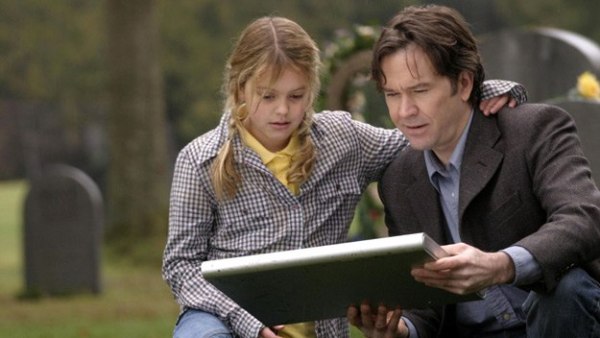
Originally a mini-series, made for cable, shown in five
parts, with a total running time of 210 minutes approx (*1). Timothy Hutton plays a physics
professor who receives a message from the future that he will be shot within
four days. Can he save his life without creating a time travel paradox that
would rip the universe apart? Who wants to kill him and why? And what’s more:
Who sent him this message?
Most critics thought 5 Days to Midnight was well
acted (notably by Hutton and 10-year old Gage Golightly - looking like
a young Drew Barrymore - who plays his daughter), but also thought it was way
overlong and anti-climactic. It was re-edited and released on DVD, in two parts
of 90 minutes, reducing the total running time by half an hour. It still looks
a little overlong, and it takes a bit too much time to get going, but once it
does, there are enough ideas, questions, twists and turns to keep you hooked.
The ending is indeed a little anti-climactic, but the answer to the question
who actually sent the message is quite intriguing.
I bought the DVD for less than 2 euros (3 DVDs for 5 euros).
They were well-spent
⭐⭐⭐
5 Days to Midnight (2004) - Cast: Timothy Hutton (Professor J.T. Neumeyer), Randy Quaid (Irwin Sikorski), Kari Matchett (Claudia Whitney), Hamish Linklater (Carl Axelrod), Angus Macfadyen (Roy Bremmer), Gage Golightly (Jesse Neumeyer)
Note:
* (1) Some sources mention a running-time of 255 minutes, but this is most probably the running-time of the original showings on Cable TV, including recaps (at the start of every new episode) and commercial breaks.
A Belgian
thriller-drama that owes as much to the Dardenne Brothers as to the Coen
Brothers. If this sounds weird, it should.
Four years
ago a home-jacking performed by three drug-addicts - two brothers, Kenny and
David, and Kenny's girlfriend Sylvie - went fatally wrong: Kenny, the youngest and
most unstable of the two brothers - was arrested, the two others got away. Kenny
took the fall for what happened and spent four years behind bars. When he's
released from jail, he assumes that he can have a fresh new start, as if things haven't changed at all. In
realityDave and
Sylvie are now both clean and they have also become a couple ... and Sylvie is expecting
their love child ...
Kevin
Janssens is perfectly believable as the thuggish
Kenny and Jeroen Perceval (who co-wrote the script) and Veerle Baetens are
nearly as good as the love birds who are very reluctant (for all the good
reasons) to inform Kenny about the situation. On script level, there are a few issues. The first half of the movie - the Dardenne part, so to speak - is a
psychological drama in which not too much happens and most fears and worries remain
unspoken. The script takes a radical turn when Kenny confronts his brother with
a dead body in the trunk of his car and asks his help to get rid of the corpse.
We move to the Ardennes, where the boys have spent many lucky days when they
were young. Kenny's former inmate seems willing to give them some assistance,
but in the Ardennnes danger is lurking around every corner, around every tree
...
The first half of the movie may be slow-paced and a bit
ponderous, but tension is always in the air and the behavior of the three
characters seems logical in the light of what happened in the past. The suburbs
of Antwerp are shown as dreary places dominated by grey multi-storey buildings
and a permanent drizzle. The second
half of the movie is more vivid and eventful, but the shift in tone from drama to nasty thriller is too abrupt. The
Coen Brothers' movies (in particular Fargo) were obviously a major source of
inspiration, but Pront (who has a brisk, energetic directional style) seems to
lack their wit and famous sarcastic touches. As a result an interlude involving
ostriches - of all animals - falls flat. The script also becomes a bit
haphazard, with too many weird characters and plot twists, but the final twist
(which will take most viewers by complete surprise) seems to make it all click,
or at least nearly so.
D'Ardennen
is not as bizarre as Calvaire (2004, Fabrice Du Welz), nor is it quite as dark
and disturbing as the more recent De Verhandeling (The Treatment - 2014, Hans
Herbots), but it's still quite bleak and grim and it will no doubt be too
downbeat and nihilistic to some people's taste: The characters are low-lives,
they act foolishly and there's no excuse for their behavior, they are not
redeemed. It's far from perfect, but I would like to recommend it in spite of
its obvious flaws.
⭐⭐⭐
Dir: Robin Pront - Kevin Janssens (Kenny), Veerle Baetens (Sylvie), Jeroen Perceval (Dave), Jan Bijvoet (Stef), Sam Louwyck (Joyce), Viviane DeMuynck (Mother)
Gattaca is set in a future in which genetic
engineering has become the norm: the perfect babies with their meticulously
selected characteristics are called Valids, those still conceived in the normal
way In-valids. The In-valids are of course considered second-class citizens:
what's supposed to be a Utopia, is in fact a Dystopia.
The film tells the story of an In-valid called
Vincent (Ethan Hawke) whose lifelong dream it is to make a space trip to Saturn, an enterprise not open to In-valids. With the help of a DNA broker, he gets
the chance to fulfill his dreams by adopting the identity ofa Valid called Jerome (Jude Law), a former swimming champion who was
paralyzed in a car accident. Jerome gives him samples of his blood and urine to pass the admission tests and Vincent has a leg operation to become four inches taller and look more like a former sports crack ...
Gattaca was
praised for its introspective nature: for once a SF movie did not rely on
special effects and odd techno-gadgets, but rather on the moral ambiguities of
genetic engineering and questions about identity in a world where
people have no control over their own lives unless they break the law. It was
called 'thought-provoking' and 'scientifically provocative' and it's often said
that the film vitalized the discussions on the controversial topic of genetic
engineering. Note however that most issues the script raises, are
only hinted at, and never really examined in detail. Instead the whole thing is
played out more or less like a paranoia thriller: Vincent/Jerome becomes the main suspect in a
murder case and we ask ourselves if the police - or the colleague he's flirting
with (Uma Thurman) - will find out who he is.
Often
mentioned as the first 'buddy-cop-action-comedy' (yes, that's quite a mouthful),
a sub genre very popular in the 80s and 90s. If it wasn't the first, it was the
most trendsetting, if only for casting Eddie Murphy (fresh from Saturday Night
Live) as the well-dressed, ultra cool inmate who is released for 48 hours to
help hard nosed, shabby cop Nick Nolte tracking down two cop killers and a missing sum of
money.
Mixing strong
violence with fairly lighthearted comedy, director Walter Hill introduced a brisk,
tongue-in-cheek style of film making that would dominate Hollywood action movies (not
only cop thrillers) for the next decade. He was asked by the producers to tone
down the violence, but the action scenes are still quite potent, notably an
early shootout in a hotel which sets the whole thing in motion.
The film works
thanks to the charisma of the two leads, but the rather flimsy script (see under miscellaneous) has not emerged
unscathed from the numerous rewritings it was submitted to. A more
intriguing idea about the criminals kidnapping the local governor's daughter and
threatening to kill her within 48 hours unless a large ransom money is paid,
was dropped in favour of more screen time for Murphy and his routines. The
scene with Murphy personating as a police offer and searching and snarling at a
redneck ("I'm you worst nightmare, a nigger with a badge!") is a
standout, other routines have become too familiar over the years.
48 Hrs. is
still quite enjoyable, but it suffers from this typical noisiness that marred
many movies from the Eighties, with the actors shouting at each other most of the
time (apparently that was supposed to be funny in those days) . The shouting wears you off after a while, but
luckily the film has a running-time of a mere 90 minutes.
Miscellaneous:
The film
apparently had a long and interesting genesis: the original idea of a cop
solving a kidnapping with the help of a released inmate (the former partner of
the kidnapper) dates from the early Seventies. According to Walter Hill, he was
asked in the late Seventies to rewrite the script as a vehicle for Clint
Eastwood and Richard Pryor, but the project was abandoned because Eastwood
wanted to play the criminal. The project then went from Columbia to Paramount
and was finally turned into a Murphy-Nolte vehicle, with Walter Hill co-scripting
and directing
Three Billboards Outside Ebbing, Missouri
(2017, Martin McDonagh)
The premise of
Three Billboards (etc.) is quite simple: months have passed since a young girl
was brutally raped and murdered in Ebbing, Missouri, and the local police force
seems to have given up the case. Her mother then hires three billboards outside
town to accuse the chief of police of negligence ... Problem is: this chief of
police is not an asshole, but a nice guy who did his best to solve the crime and he also happens to suffer from
terminal pancreas cancer. When Willoughby commits suicide because of his
illness and the unbearable pains he'll have to endure, the inhabitants think he
did it because of the three billboards outside town and blame Mildred ...
And all
hell breaks loose ...
What kind
of movie is this? A black comedy? Or is it a serious drama that is at the same
time funny? Whatever it is, it is well-made and tremendously well-acted. Both
Frances McDormand and Woody Harrelson are perfectly cast as the two main
opponents, the mother and the chief of police, and Sam Rockwell turns in a terrific
performance as the redneck sergeant who still lives with his mum. This is a better
movie than The Shape of Water, its major rival in the Oscar race for Best
Picture, but it's not flawless either.
Writer/director
McDonagh skillfully plays with people's expectations, revealing layer after
layer of both the movie's plot and characters. The story will most certainly keep
you hooked, but some of its contrivances seem a little absurd. Three Billboards
is about traumatic experiences people are unable to forget, but most characters
seem strangely unaffected by what's happening to them (or to others) in the
course of the movie. In Ebbing, Missouri you can burn down an entire police
station and even a person who nearly died in the fire won't bear a grudge
against you. And like one critic wrote: the conclusion seems to be that it's
okay to be a cunt, but not a dick (*1).
Controversy
Ironically
the film's script was criticized by some, not because of its improbabilities,
but because it seems to condone sergeant Dixon's redneck behavior. Through a
series of machinations the character is turned, in the final stages of the
movie, from a brute into a more amiable person. Obviously the intension of the film makers was
to illustrate his growth as a person, not to condone his racist ideas (he was
clearly presented as an immature person in the first three quarters of the
movie), but most of these machinations rely too much on coincidence or sound so
far-fetched that the whole idea of redemption and forgiveness is blurred.
That man is
Wyatt, knick-named Captain America because of the Stars & Stripes on his
helmet and chopper. He and his friend Billy want to join the Mardi Grass
festivities in New Orleans. En route they pick up a hitch-hiker, visit a hippie
community, are arrested when joining a parade without permit, meet an alcoholic
lawyer in jail, attract some undesired attention of locals and have a bad acid trip.
They eventually reach New Orleans, so Billy thinks they made it, but
Captain America, the more philosophical of the two, knows better: they blew it.
They have reached New Orleans, but haven't found America.
Fonda and
Hopper had both appeared in biker movies before (Fonda in The Wild Angels,
Hopper in The Glory Stompers) but Easy Rider is *not* just another movie about biker
gangs or outlaw bikers: Captain America and his friend are involved in drug
smuggling at the beginning of the movie, but they're no outlaws or Hell's
Angels and the movie refrains from the gratuitous violence of the previous
biker movies. Wyatt and Bill are freewheeling bikers: they're
anti-establishment but not anti-social. They envy a farmer who lives off the
land with his large family ("You can be proud of yourself"). At some
point, George Hanson, the alcohol lawyer (Jack Nicholson) says:
" You
know, this used to be a helluva good country. I can't understand what's gone
wrong with it."
Easy Rider is
a movie about a country in transition, about the collision of the Old and New,
of the City versus the Countryside, of what has vanished and what is
yet to come. Fonda had the idea to construct the movie as a new kind of
western: he had recently watched John Ford's The Searchers (1956) in which the
protagonists are looking for a girl who was abducted by the Indians; in Easy
Rider the two would instead be looking for America. Wyatt and Billy are named
after Wyatt Earp and Billy the Kid and their journey to the East mirrors the trek
to the West of the original settlers: voyagers go looking for a better life and
discover that the paradise they were dreaming is not up there for the grabs.
From the
start, Easy Rider was a Fonda-Hopper project: Fonda would produce, Hopper
direct and both would work on the script. A rough cut had
a much longer running-time and an experimental structure, but in
post-production most story elements and experimental narrative effects (flash forwards, jump cuts, hand-held camera shots, etc.) were edited out. The finished movie
is a succession of vignettes, all with their own mood and structure, virtually without any overarching narrative. On the
surface, Easy Rider offers a typical, almost stereotyped image of the Sixties:drugs, hippies, free love; it also shares
some of its obsessions of the decade about the end of materialism and going back
to nature, but it's not naïve in its approach: it's a movie about the dreams
the young ones had, but also about their disillusions.
The movie is
immensely helped by László Kovács' magnificent cinematography of the landscape
and a now classic soundtrack. Crosby, Stills, Nash & Young were asked to
write an original score, but eventually it was decided to use existing tracks
by Steppenwolf, The Byrds, the Band, Jimi Hendrix and others.
⭐⭐⭐⭐
Miscellaneous:
* The title
'Easy Rider' is a little erratic. Most people have interpreted as a reference
to bikers, but its original meaning was a horseman or a horse easy to ride. In the
Sixties it was used in relation to free love: men who lived with women who
practiced it, had a 'free ride'. Occasionally the term was also used for
someone who visited prostitutes (the boys in fact visit a whorehouse in New
Orleans)
* The
tracks used on the soundtrack were chosen by editor Donn Cambern; he used music
from his own record collection 'to get in the mood' during the editing process.
When confronted with some of the results, Fonda and Hopper decided to skip the
ideas for an original soundtrack by CSN&Y. In return Hopper grew a David Crosby moustache for the movie ...
_____________
1969 -
Directed by Dennis Hopper, produced by Peter Fonda, written by Peter Fonda,
Terry Southern and Dennis Hopper - Cast: Peter Fonda, Dennis Hopper, Jack
Nicholson, Luke Askew, Karen Black, Michael Pataki, Toni Basil
I had not
planned to see it, at least not in theatres, but I was in the company of
somebody very dear to my heart who desperately wanted to see it before
it would get all those Oscars, so I decided to give it a try. What shall I say?
It was a bit better than I had expected, but like most of this director's work,
it didn't do much for me.
Most of you
will know that it tells a story about a forbidden love. Sally Hawkins is a mute
custodian at a secret government laboratory where an amphibious
creature, captured in the Andes, is studied by a team of scientists and put to
some grueling tests. While visiting him, the woman
and the creature start developing a strong bond. Eventually they will fall in
love. In most classic love stories of this type - Romeo & Juliet, Anna
Karenina, even Titanic - the barriers are social, and the lovers die in each
others' arms. In the case of Del Toro's movie the barriers are biological and -
this is probably the most original angle - the lovers manage to overcome the
ultimate barrier: Love literally overcomes Death, the lovers literally live
happily ever after.
That's all
okay, this is a fairy tale with horror influences (and some religious
overtones), The Beauty and the Beast with a sniff of the Frankenstein myth. The
story is set in 1962 Baltimore, during the days of the Cold War and both Super
Powers are interested in the creature; the espionage story adds some suspense
to the plot, but be forewarned: some of the scenes of violence and torture are
quite gruesome. The shape of Water is by no means a bad movie, it's a good one that will no doubt hold your attention, but the problem
- at least my problem - is that you sense that the movie is desperately trying
to *say* something, no doubt something of great importance. In interviews the
director himself mentioned the refugee crisis. In his words this was a
Hollywood movie made by an immigrant. True of course, but I don't care for
messages, at least not in movies. Messages belong in bottles, and if I need
one, I pick one up at the seashore.
If you'll
look past the gloss, you'll notice that The Shape of Water is a rather empty
audience pleaser that is not as original as it may seem. But it's wonderfully
acted and beautifully made. Sally Hawkins is sweet and winsome (you can't think
of anybody else in this role) and the creature looks alive, will never give you
the idea you're looking at the proverbial 'man in a suit'. And the sugary
message will no doubt please moviegoers and Academies. Four Oscars you say?
Thought so.
⭐⭐½
Dir: Guillermo del Toro - Cast: Sally Hawkins (Elisa), Michael Shannon (Strickland), Richard Jenkins (Giles), Octavia Spencer (Zelda), Michael Stuhlbarg (Dimitri Mosenkov/Dr. Robert Hoffstetler), Nigel Bennett (Mihalkov), Lauren Lee Smith (Elaine Strickland), John Kapelos (Mr. Arzoumanian), Martin Roach (Brewster)
The movie,
not the TV-show. It was a smash hit in theatres when I was a teenager and we
all went to see it, even when we didn't have the right age (it had an '18
rating'). Today, half a century later, it's still an entertaining movie, but
it's hard to understand why an entire generation went raving mad about it.
MASH is set
during the Korean war (1950-1953), but the subtext is the war in Vietnam. The raunchy
jokes, the haircuts and moustaches are all Sixties, not Fifties. Donald
Sutherland and Elliot Gould are Hawkeye and Trapper John, surgeons in a Mobile
Army Surgical Hospital (hence the title). They are not passionate about the war, but dedicated to
saving people's lives. They reject protocol and view those who respect it with
cold contempt. Sutherland and Gould look and behave like hippies and the growing
protests against the Vietnam War must have helped the movie a lot: it was
interpreted as a protest to America's military operations in the Far East. Mash
was anti-establishment, Mash was counterculture, Mash was ahead of its time. At least we thought it was all these things.
The movie is
a collection of vignettes, with hardly any coherent narrative. Director Robert
Altman realized his episodic
movie needed more structure and therefore added a series of speaker
announcements to connect the different episodes. Those announcements are
occasionally funny, but don't really solve the problem: the whole thing still
feels rather disjointed.
As said, Mash
is still enjoyable, the episodic action has a nice flow and the actors are very
good. Sutherland and Gould underplay their roles, which suits the material very
well, and Sally Kellerman is a delight as Major Margaret 'Hotlips' Houlihan, the
straitlaced, yet lascivious nurse who is the obvious target of many of the
boys' practical jokes. But there's this feeling that it belongs to another era. Above all, it's not as funny as it used to be. Mash was an
immensely popular movie and the raunchy jokes - like Hotlip's infamous shower
scene - seem to have influenced directors of sex comedies, a popular subgenres
from the first half of the Seventies. What used to be daring and outrageously funny
may now give you the idea that you're watching one the entries in the long
running Porky's series.
⭐⭐⭐½
1970 - Dir: Robert Altman - Cast: Donald Sutherland (Hawkeye), Elliot Gould (Trapper John), Sally Kellerman (Hotlips), Tom Skerritt (Duke), Robert Duvall (Major Burns), Roger Bowen (Lt.-Col. Blake), Jo Ann Pflug (Dish), Gary Burghoff (Radar)
One of
Belmondo's better movies from the Seventies.At first glance it looks like a sequel to L'Homme de Rio, the spoofy espionage
flick he had made a decade earlier (with the same director), but Le Magnifique
goes one step further: Belmondo not only plays the superspy, but also the
author who created him, turning the movie into a *spoof of a spoof*.
Belmondo is
François Merlin, a social pariah who has written 42 pulp novels about a super
hero called Bob St. Clair. François has modeled Bob after himself, but in his
fantasy world Bob is of course everything his creator is not: he's the epitome of courage and charm, an
infallible action hero and a lady killer. François can't pay his bills and
is madly in love with his neighbor, Christine, a sociology student (played by
Jacqueline Bisset!), who has no eyes for him. In the novels Christine has
become Tatiana, Bob's lover and side-kick ...
Veering
between François's fantasy world and his everyday life, the film not only parodies
the espionage genre à la James Bond, but also Belmondo's own screen persona. The
script is a bit of a mishmash, which is no wonder if you know its genesis: It was
co-written by director de Broca and Francis Veber (best known for comedies like La Chèvre and Les Compères, both starring Gérard Depardieu and Pierre Richard),
but the two couldn't agree on some aspects of the story (most of them related
to Jacqueline Bisset's character) and eventually a script doctor was hired to finish the job (*1). Some of the gory jokes may look
tasteless today, but they were meant to poke fun at the blood-spattered cinema
à la Peckinpah that was very popular in those days. Overall Le Magnifique is quite
funny, occasionally even touching. And Jolie Jacqueline is pure eye candy.
⭐⭐⭐
Note:
* (1)
According to some sources Italian actor Vittorio Caprioli also contributed to
the final script. To avoid any
possible legal action by one of the people concerned, nobody - not even De
Broca and Veber - was credited for his work.
1973 - Dir:
Philippe De Broca - Cast: Jean-Paul Belmondo (François/Bob St. Clair), Jacqueline Bisset (Christine/Tatiana), Vittorio
Caprioli (Charron/Karpof), Jean Lefèbvre, Hubert Deschamps, Hans Meyer - Music: Claude Bolling
A feature
length debut for its director, this horror movie with satirical overtones became
a sensational hit in the US and abroad.
Chris, a
young Afro-American guy, reluctantly accepts the invitation of his white
girlfriend Rose to spend a weekend at her parents' home, an isolated estate in
the countryside. Chris immediately starts having odd feelings about the
atmosphere on the estate but concludes that Rose's parents are unsure
about their daughter's interracial relationship. He's an understanding guy and
thinks it's all understandable. But soon things start becoming more unsettling
and ... well, you'd better find out for yourself what is exactly going on over
there.
This is
clearly a liberal movie aimed a liberal audiences. This might - at least for a
part - explain its immense success and critical acclaim (it holds a 99%
approval rating at rotten tomatoes): critics must have felt that negative reactions
would inevitably lead to accusations of racial prejudice (or worse). The
villains in the movie are no rednecks, but the kind of white people - labeled
ironically as 'West-Wing liberals' in some comments - who would have voted for Obama for the third
time and support movements against racism. But for all their good intentions,
they wouldn't consider - not even for a moment - to give up their comfortable social positions. In other words: it's all about white privilege. If that's the
message you want to hear, this is the movie you were waiting for.
It's easy
to understand why people like this movie, but I don't share their enthusiasm. Get
Out isn't bad, it tackles serious social problems, it's very well acted
(especially by Daniel Kaluuya as Chris) and it most certainly will hold your
attention. But as a satire it's often too blunt, too unsubtle to be incisive
and as a horror movie it feels too much like Frankenstein for the Millennium
generation to be fully effective. Director Peele is best known for his
contributions (both as an actor and writer) to comedy shows like Key &
Peele and MadTv and his movie offers a few very funny moments but
they almost feel out of place. Unfortunately Peele also robs his movie from its most logical ending by
introducing a final twist that virtually denies the entire movie. The original
ending was filmed and is still available as an extra on various releases, but apparently
Peele was afraid to hurt audiences' feelings with it.
___________________________________
Director:
Jordan Peele - Cast: Daniel Kaluuya (Chris), Allison Williams (Rose Armitage), Bradley
Whitford (Dean Armitage), Catherine Keener (Missy Armitage), Caleb Landry Jones
(Jeremy Armitage), Lil Rel Howery (Rod ), Betty Gabriel (Georgina), Marcus
Henderson (Walter), LaKeith Stanfield,
Stephen Root, Erika Alexander, Geraldine Singer