zondag 29 september 2019

Take the Money and Run (1969)


I must have seen this movie – Woody’s first directional effort -  in the early 1980s, when Woody had become a household name in intellectual circles. We were all intellectuals, at least we thought we were, so we all went to see his movies, old and new.

Apparently Woody had wanted Jerry Lewis to direct, but when this didn’t work out, he decided to do it all by himself. It's nevertheless clear that Jerry Lewis was one of his major sources of inspiration, along with Charles Chaplin and (so he has pointed out repeatedly) Bob Hope. But the so-called mockumentary style - mixing stock material with fake interviews and using a voice-over to connect the various vignettes - is entirely his own. It's a concept that he would use more often in the course of his career. 

Woody is Virgil Starkwell, a bespectacled Jewish boy who is constantly bullied by kids from the neighborhood, who are bigger and stronger. As an adult, he makes himself a name as the most inept criminal in recent memory, whose robberies inevitably end in failure (and he behind bars). The police and even judges keep crashing his spectacles, like the bullies from his neighborhood.

The mockumentary style serves the material rather well, even if Woody keeps cramming too many jokes in those voice-overs. Thee crossfire of visual and verbal jokes will no doubt overstretch some viewers' attention span. As for the jokes: some work, others don't, the worst are occasionally horrendous, but the better ones are often hilarious and the most memorable joke of the entire movie, the bank robbery that goes wrong because he misspelled the word 'gun' in his threatening note (What's a gub?), is brilliant. Only problem: it goes on too long.  

Woody still had to learn a few things, but, as said, Take the Money and Run is often very funny and many fans think it's the best movie of his early days as a film maker.


1969 - Dir: Woody Allen - Screenplay: Woody Allen, Mickey Rose - Cast: Woody Allen, Janet Margolin, Marcel Hillaire, Jacquelyn Hyde, Ethel Sokolow, Dan Frazer, Henry Leff, Louise Lasser - Music: Marvin Hamlisch

zaterdag 27 april 2019

Funan, Le Peuple Nouveau (2018)


FUNAN Le Peuple Nouveau 
(Frankrijk, Luxemburg, Belgiƫ, Cambodja - 2018, Denis Do)

Een animatiefilm - gezien op festival MOOOV - van de in Frankrijk geboren regisseur Denis Do, van gemengd Frans-Cambodjaanse afkomst. Het scenario is gebaseerd op de verhalen van zijn Cambodjaanse moeder, het hoofdpersonage Chou is op haar gebaseerd. De film speelt zich af in de periode 1975-1979, ten tijde van het regime van de Rode Khmer.

Chou en haar echtgenoot wonen in Phnom Penh, samen met hun 3-jarig zoontje Sovanh. Na de machtsovername door de Rode Khmer worden de inwoners geƫvacueerd en in werkkampen ondergebracht, waar ze worden onderworpen aan slavenarbeid voor de revolutie. Daarbij raakt Sovanh van zijn ouders gescheiden. De Rode Khmer beloven rechtvaardigheid en gelijkheid, maar ondanks alle schone beloftes, krijgen de ouders zelfs geen toestemming om naar hun kind te gaan zoeken: 'het regime zal wel voor hem zorgen'. Uiteindelijk zal het schrikbewind van de communisten zo'n 2 miljoen slachtoffers onder de burgerbevolking maken. Ondanks de terreur en voortdurende bedreigingen, geven Chou en haar echtgenoot nooit de moed op om Sovanh terug te zien.

Funan is indrukwekkend, maar tegelijkertijd ook een beetje teleurstellend. De vertelling is tamelijk brokkelig, waardoor je als kijker zeker in het begin maar moeilijk in het verhaal raakt. De film lijkt soms te veel een soort 'Killing Fields voor beginners': wie de geschiedenis een beetje kent, zal weinig nieuwe feiten of inzichten opdoen. Anderzijds: voor velen zijn de killing fields iets van 'voor hun tijd', iets wat nauwelijks het weten waard is. Het eenheidsdenken is weer in opmars, ook in onze contreien, en de schone beloftes van het communisme voeren op veel jongeren weer de nodige aantrekkingskracht uit. Wellicht biedt deze film ze stof tot nadenken.

Technisch is Funan zeer verzorgd, visueel is de film een pareltje; vooral de weergave van het Cambodjaanse platteland is vaak hypnotisch mooi. Het is wel vreemd om alle personages Frans te horen spreken.


⭐⭐⭐

2018 - Regie: Denis Do -  Scenario: Denis Do, Magali Pouzot, Elise Trinh - Animatie: Eleonora Guerra, Pascal Vermeersch, Paul Raymond Williams - Artistieke leiding: Michael Crouzat - 84 minuten


zaterdag 12 januari 2019

The Final Countdown (1980)


Again Time Travel, and again the Time Travel Paradox. The film (unrelated to the well-known pop song) tells the story of the USS Nimitz, a modern aircraft carrier that - during a heavy thunderstorm - passes through a time warp and ends up near Pearl Harbor, on the eve of the Japanese attack. Should Captain Kirk Douglas and his crew take action, prevent the destruction of Pearl Harbor and change history?

The Final Countdown was produced on a limited budget; as a result the special effects are awful, but the US Navy (who reportedly liked the premise) gave permission to shoot scenes on the actual aircraft carrier USS Nimitz. We get several spectacular scenes of planes landing on the aircraft deck and crew members serve as extra's, which adds to the feeling of authenticity. 

But what about the story? Well, Captain Kirk and his staff have elaborate discussions about the situation. Is it real? Is it possible to intervene? As one of the characters puts it:

"If I go back in time to kill my grandfather, how could I ever be born, and if I was never born, how could I ever go back in time?"

In order words: if we alter history, what would happen to us? Or to our relatives, friends and allies? The attack on Pearl Harbor gave US President Roosevelt an excuse to enter the Second World War, and provided him with a perfect argument to convince isolationists. How would WWII have progressed without US involvement? How would post-war Western European countries have looked like? Would they have suffered a Nazi dictatorship? Become Soviet satellite stated maybe? As said, these problems are never discussed, only vaguely hinted at by the introduction of the fictional character of a US senator (played by Charles Durning) who shares Roosevelt's views and wants the USS Nimitz to intercept the Japanese fleet.

The direction is workmanlike and with its lackluster special effects the film may look like an extended episode of The Twilight Zone, but thanks to some clever plotting and some good performances it's remarkably enjoyable ... until the finale, or better: the lack of it. Movies about the time travel paradox often have a sort of cop out ending, and this one's no exception: after careful consideration Captain Kirk takes a decision and we seem to be heading for a spectacular showdown, but no, all of sudden he has second thoughts and withdraws his decision. Why? Your guess is as good as mine.

⭐⭐⭐

The Final Countdown (1980, Don Taylor) - Cast: Kirk Douglas (Capt. Yelland), Martin Sheen (Lasky), Katherine Ross (Laurel Scott), James Farentino (Wing Commander Owens), Charles Durning (Senator Chapman), Sonn Tek-Oh (Simura), Alvin Ing (Lt. Kajima)

5 Days to Midnight (2004)


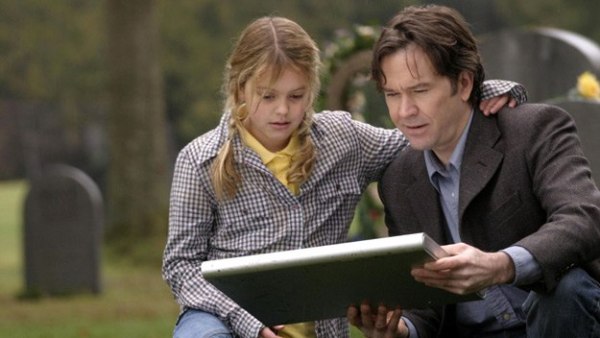
Originally a mini-series, made for cable, shown in five parts, with a total running time of 210 minutes approx (*1). Timothy Hutton plays a physics professor who receives a message from the future that he will be shot within four days. Can he save his life without creating a time travel paradox that would rip the universe apart? Who wants to kill him and why? And what’s more: Who sent him this message?

Most critics thought 5 Days to Midnight was well acted (notably by Hutton and 10-year old Gage Golightly - looking like a young Drew Barrymore - who plays his daughter), but also thought it was way overlong and anti-climactic. It was re-edited and released on DVD, in two parts of 90 minutes, reducing the total running time by half an hour. It still looks a little overlong, and it takes a bit too much time to get going, but once it does, there are enough ideas, questions, twists and turns to keep you hooked. The ending is indeed a little anti-climactic, but the answer to the question who actually sent the message is quite intriguing.

I bought the DVD for less than 2 euros (3 DVDs for 5 euros). They were well-spent


⭐⭐⭐

5 Days to Midnight (2004) - Cast: Timothy Hutton (Professor J.T. Neumeyer), Randy Quaid (Irwin Sikorski), Kari Matchett (Claudia Whitney), Hamish Linklater (Carl Axelrod), Angus Macfadyen (Roy Bremmer), Gage Golightly (Jesse Neumeyer)

Note: 

* (1) Some sources mention a running-time of 255 minutes, but this is most probably the running-time of the original showings on Cable TV, including recaps (at the start of every new episode) and commercial breaks. 

donderdag 1 november 2018

D'Ardennen (The Ardennes, 2015)

D'Ardennnen (The Ardennes - 2015, Robin Pront) 

A Belgian thriller-drama that owes as much to the Dardenne Brothers as to the Coen Brothers. If this sounds weird, it should.

Four years ago a home-jacking performed by three drug-addicts - two brothers, Kenny and David, and Kenny's girlfriend Sylvie -  went fatally wrong: Kenny, the youngest and most unstable of the two brothers - was arrested, the two others got away. Kenny took the fall for what happened and spent four years behind bars. When he's released from jail, he assumes that he can have a fresh new start, as if things haven't changed at all. In reality  Dave and Sylvie are now both clean and they have also become a couple ... and Sylvie is expecting their love child ...

Kevin Janssens is perfectly believable  as the thuggish Kenny and Jeroen Perceval (who co-wrote the script) and Veerle Baetens are nearly as good as the love birds who are very reluctant (for all the good reasons) to inform Kenny about the situation. On script level, there are a few issues. The first half of the movie - the Dardenne part, so to speak - is a psychological drama in which not too much happens and most fears and worries remain unspoken. The script takes a radical turn when Kenny confronts his brother with a dead body in the trunk of his car and asks his help to get rid of the corpse. We move to the Ardennes, where the boys have spent many lucky days when they were young. Kenny's former inmate seems willing to give them some assistance, but in the Ardennnes danger is lurking around every corner, around every tree ...

The first half of the movie may be slow-paced and a bit ponderous, but tension is always in the air and the behavior of the three characters seems logical in the light of what happened in the past. The suburbs of Antwerp are shown as dreary places dominated by grey multi-storey buildings and a permanent drizzle. The second half of the movie is more vivid and eventful, but the shift in tone from drama to nasty thriller is too abrupt. The Coen Brothers' movies (in particular Fargo) were obviously a major source of inspiration, but Pront (who has a brisk, energetic directional style) seems to lack their wit and famous sarcastic touches. As a result an interlude involving ostriches - of all animals - falls flat. The script also becomes a bit haphazard, with too many weird characters and plot twists, but the final twist (which will take most viewers by complete surprise) seems to make it all click, or at least nearly so.

D'Ardennen is not as bizarre as Calvaire (2004, Fabrice Du Welz), nor is it quite as dark and disturbing as the more recent De Verhandeling (The Treatment - 2014, Hans Herbots), but it's still quite bleak and grim and it will no doubt be too downbeat and nihilistic to some people's taste: The characters are low-lives, they act foolishly and there's no excuse for their behavior, they are not redeemed. It's far from perfect, but I would like to recommend it in spite of its obvious flaws. 

⭐⭐⭐

Dir: Robin Pront - Kevin Janssens (Kenny), Veerle Baetens (Sylvie), Jeroen Perceval (Dave), Jan Bijvoet (Stef), Sam Louwyck (Joyce), Viviane DeMuynck (Mother)


maandag 29 oktober 2018

Gattaca (1997)


Gattaca (1997, Andrew Niccol)

Gattaca  is set in a future in which genetic engineering has become the norm: the perfect babies with their meticulously selected characteristics are called Valids, those still conceived in the normal way In-valids. The In-valids are of course considered second-class citizens: what's supposed to be a Utopia, is in fact a Dystopia.

The film tells the story of an In-valid called Vincent (Ethan Hawke) whose lifelong dream it is to make a space trip to Saturn, an enterprise not open to In-valids. With the help of a DNA broker, he gets the chance to fulfill his dreams by adopting the identity of  a Valid called Jerome (Jude Law), a former swimming champion who was paralyzed in a car accident. Jerome gives him samples of his blood and urine to pass the admission tests and Vincent has a leg operation to become four inches taller and look more like a former sports crack ...  

Gattaca was praised for its introspective nature: for once a SF movie did not rely on special effects and odd techno-gadgets, but rather on the moral ambiguities of genetic engineering and questions about identity in a world where people have no control over their own lives unless they break the law. It was called 'thought-provoking' and 'scientifically provocative' and it's often said that the film vitalized the discussions on the controversial topic of genetic engineering. Note however that most issues the script raises, are only hinted at, and never really examined in detail. Instead the whole thing is played out more or less like a paranoia thriller:  Vincent/Jerome becomes the main suspect in a murder case and we ask ourselves if the police - or the colleague he's flirting with (Uma Thurman) - will find out who he is.


vrijdag 26 oktober 2018

48 Hrs.


48 Hrs. (1982, Walter Hill)

Often mentioned as the first 'buddy-cop-action-comedy' (yes, that's quite a mouthful), a sub genre very popular in the 80s and 90s. If it wasn't the first, it was the most trendsetting, if only for casting Eddie Murphy (fresh from Saturday Night Live) as the well-dressed, ultra cool inmate who is released for 48 hours to help hard nosed, shabby cop Nick Nolte tracking down two cop killers and a missing sum of money.

Mixing strong violence with fairly lighthearted comedy, director Walter Hill introduced a brisk, tongue-in-cheek style of film making that would dominate Hollywood action movies (not only cop thrillers) for the next decade. He was asked by the producers to tone down the violence, but the action scenes are still quite potent, notably an early shootout in a hotel which sets the whole thing in motion.

The film works thanks to the charisma of the two leads, but the rather flimsy script  (see under miscellaneous) has not emerged unscathed from the numerous rewritings it was submitted to. A more intriguing idea about the criminals kidnapping the local governor's daughter and threatening to kill her within 48 hours unless a large ransom money is paid, was dropped in favour of more screen time for Murphy and his routines. The scene with Murphy personating as a police offer and searching and snarling at a redneck ("I'm you worst nightmare, a nigger with a badge!") is a standout, other routines have become too familiar over the years.

48 Hrs. is still quite enjoyable, but it suffers from this typical noisiness that marred many movies from the Eighties, with the actors shouting at each other most of the time (apparently that was supposed to be funny in those days) . The shouting wears you off after a while, but luckily the film has a running-time of a mere 90 minutes.

Miscellaneous:

The film apparently had a long and interesting genesis: the original idea of a cop solving a kidnapping with the help of a released inmate (the former partner of the kidnapper) dates from the early Seventies. According to Walter Hill, he was asked in the late Seventies to rewrite the script as a vehicle for Clint Eastwood and Richard Pryor, but the project was abandoned because Eastwood wanted to play the criminal. The project then went from Columbia to Paramount and was finally turned into a Murphy-Nolte vehicle, with Walter Hill co-scripting and directing

⭐⭐⭐

TRACES (TV-serie, 2019)

Een mooi gemaakte, goed geacteerde serie die te lijden heeft onder een verwarde plot. Het idee voor Traces werd geleverd door de schrijfst...